Corporations and Society by M.G. Smith
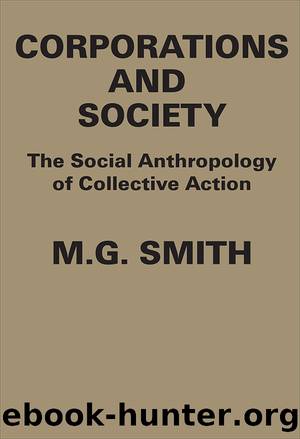
Author:M.G. Smith [Smith, M.G.]
Language: eng
Format: epub
ISBN: 9780202309484
Barnesnoble:
Goodreads: 13690692
Publisher: Routledge
Published: 1975-01-01T00:00:00+00:00
8.
Analytically, the corporations whose changing properties, relations and forms constitute changes in the structure of the political system of which they are part, are presumptively perpetual regulatory units whose differences of type, base, scope and articulation indicate and specify their differences of status. While the principles on which a unit is incorporated determine its immediate requisites and entailments and thus its minimal scope, its corporate form determines its minimally appropriate internal and external articulation, given the mode of its incorporation to its particular context. Thus in the limiting case of a perfect equilibrium, the extrinsic and intrinsic properties of the corporation must correspond perfectly, as should the requisites of its internal and external articulation, and its collective status with that of its members. In such conditions the unitâs procedures, organization and scope should correspond perfectly with one another and with its formal attributes. Accordingly, its routine activities will then manifest its public status and external articulation. The exercise of corporate authority is thus restricted to those relations and activities that sustain the order by fulfilling its requisites and implications; and any material changes in the form, capacities or bases of the unit will modify its status and articulation correspondingly. Moreover, since such developments invalidate some institutional norms, they presuppose and express corresponding changes in the alignments and orientations of power within and beyond the unit. Invariably also, such structural developments modify the articulative networks in which the unit was formerly aligned, together with its juridical status and autonomy. More extensive or critical changes may invalidate some of the unitâs requisites or entailments, and thus some conditions and features of its corporate organization. Whether such processes of change consist primarily in revisions of the external relations and status of the particular unit or in extensions or reductions of its scope, these consequences prevail. While changes of unit scale or range sometimes accompany changes of its structure, both may proceed independently; and the mere multiplication or reduction of the number of units, or simple extensions of their range, need not alter the structure of a political system, though either may clearly affect its capacity, unless some changes in the bases or modes of unit incorporation are involved.
Such structural changes in the conditions, context and articulations of a corporation modify the status and capacities of its members by altering the scope and conditions of their membership, that is, by modifying its distinctive rights, duties, privileges and relations, and sometimes by transforming the bases and categories of membership also. Such modifications of membership content commonly take either of three alternative courses. First, the content of membership and thus the scope of the corporate unit may be extended, for example by the acquisition of new collective functions and resources, conditionally or otherwise. Alternatively, membership content and collective scope may be reduced by loss or restriction of former capacity or autonomy. Finally the content of corporate membership may be altered, with or without any accompanying changes in the unitâs autonomy and scope, by some revision of
Download
This site does not store any files on its server. We only index and link to content provided by other sites. Please contact the content providers to delete copyright contents if any and email us, we'll remove relevant links or contents immediately.
1989 by Peter Millar(900)
A Man Named Dave by Dave Pelzer(826)
The Heart of a Boy by Kate T. Parker(786)
Where Children Run by Karen Emilson(676)
Scout Tests by Bear Grylls(594)
The History of Childhood by DeMause Lloyd(581)
The Wonder of Children by Michael Gurian(563)
Baby X by Keeble Harry(561)
The History of Childhood by James Marten(541)
Negotiating Fatherhood by Thomas Fletcher(534)
Help at any cost by Maia Szalavitz(526)
It's OK to Go Up the Slide by Heather Shumaker(519)
Girls on the Edge by Sax Leonard;(508)
The Sexualization of Childhood (Childhood in America) by Sharna Olfman(505)
The History of Childhood by Lloyd Demause(496)
Negotiating at Home: Essential Steps for Reaching Agreement with Your Kids by Kurtzberg Terri R.; Kern Mary C.;(453)
Blue Above the Chimneys by Fraser Christine Marion(441)
The Pale-Faced Lie: A True Story by David Crow(441)
Unequal Childhoods by Annette Lareau(437)
